

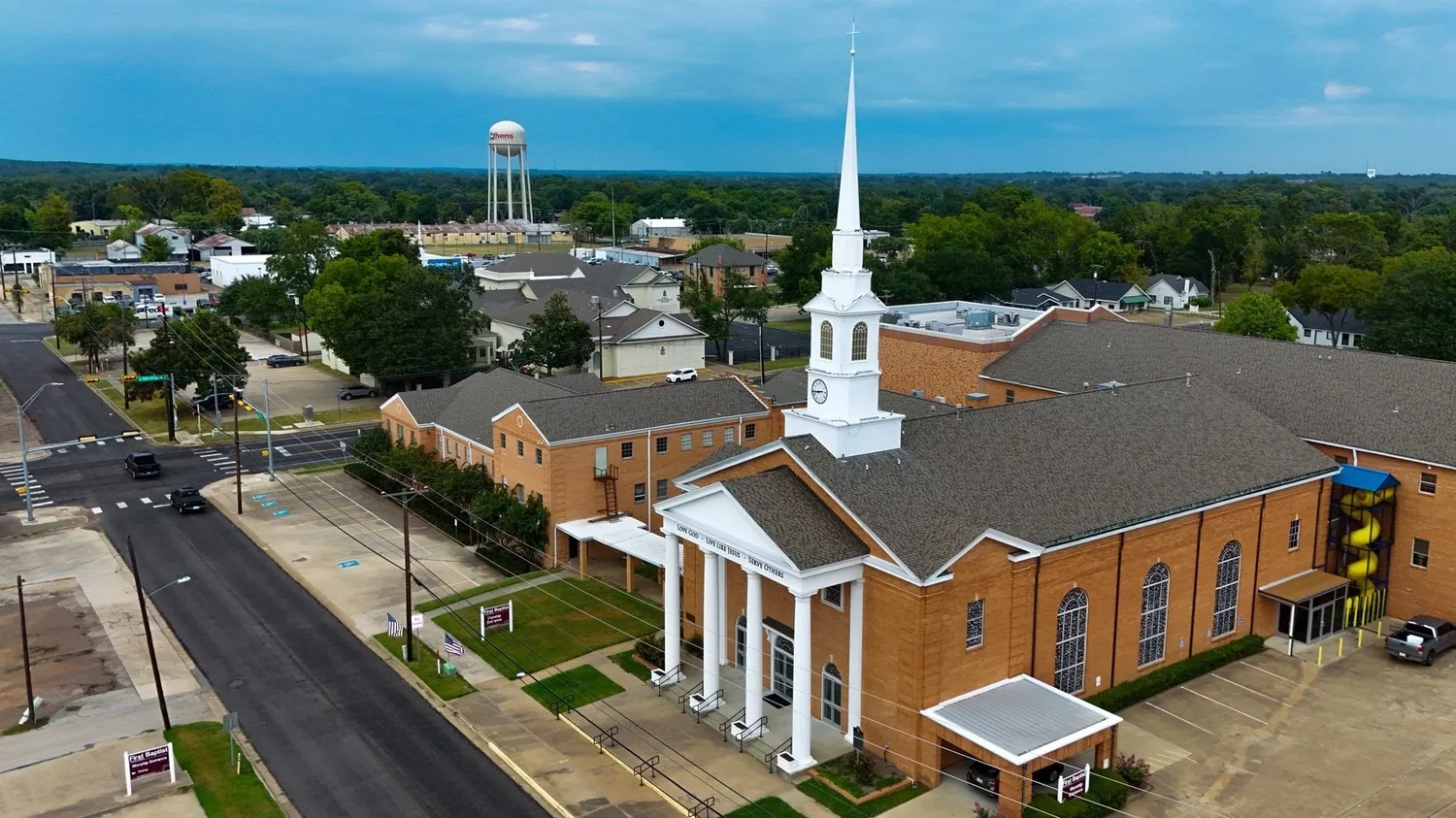
Giving at FBCA
Text to Give
If you would like to give via texting, you may text FIRSTBAPTISTATHENS to 77977
FIRST TIME: A link will guide you to input credit/debit card information.
NOTE: When you send 'FIRSTBAPTISTATHENS' to 77977 you will receive a one time reply containing a link to give to First Baptist Church Athens (1msg/request). Please be aware that Msg & Data rates may apply. For full Terms & Conditions please visit https://pushpay.com/terms. For the Privacy Policy please visit https://pushpay.com/privacy. For help reply HELP or STOP to cancel.
Why Give?
What does the Bible teach about giving?
-
Each one must give as he has decided in his heart, not reluctantly or under compulsion, for God loves a cheerful giver. Read More
God loves (in the sense of “approves of”) a cheerful giver, an allusion to Prov. 22:9 in the Septuagint (cf. Deut. 15:10; Rom. 12:8). God loves such joy-motivated giving to others because it expresses contentment in God’s gracious giving to the believer (see 2 Cor. 9:14) that makes every good work possible and results in thanksgiving and glory to God (see 2 Cor. 9:11–13).
-
“Thus, when you give to the needy, sound no trumpet before you, as the hypocrites do in the synagogues and in the streets, that they may be praised by others. Truly, I say to you, they have received their reward. But when you give to the needy, do not let your left hand know what your right hand is doing, so that your giving may be in secret. And your Father who sees in secret will reward you. Read More
Hypocrites originally referred to Greek actors who wore different masks to play various roles. Jesus criticizes the religious leaders, most notably the Pharisees, for a particular form of hypocrisy: doing right things for the wrong reasons. To give to the needy was one of the pillars of piety, but the religious leaders gave to the needy in order to be praised by others. The tragic irony was that they had received their reward of public and professional acclaim, but that was all the reward they would ever receive, and such fleeting human adulation precludes satisfaction of the deep longing of people’s hearts to stand approved by their Father who sees in secret.
-
For there will never cease to be poor in the land. Therefore I command you, ‘You shall open wide your hand to your brother, to the needy and to the poor, in your land.’Read More
The ideal in v. 4 is in effect a command to be generous: Let there be no poor among you.Since the land will be sufficiently blessed by God (v. 6), provided the economic laws are upheld (v. 5), there should be no one who is poor. Verse 11 perhaps expresses the reality that Israel will fail to fulfill the law and thus there will always be poor and the need for generosity. you shall lend to many nations, but you shall not borrow. Israel will be rich in blessing, if there is obedience (v. 5).
-
If a brother or sister is poorly clothed and lacking in daily food, and one of you says to them, “Go in peace, be warmed and filled,” without giving them the things needed for the body, what good is that? So also faith by itself, if it does not have works, is dead. Read More
An illustration of what faith without works looks like in everyday life. In itself the phrase Go in peace, be warmed and filled is a pious wish and prayer for the welfare of the poor, but in reality it is a cop-out, masking a refusal to help the person in need. There is no good(Gk. ophelos, “profit, honor”) in such a prayer.
-
Honor the LORD with your wealth and with the firstfruits of all your produce; then your barns will be filled with plenty, and your vats will be bursting with wine. Read More
Honor the LORD. This requires giving proper weight to your wealth by using it only for righteous, just, and equitable purposes (“in all your ways acknowledge him,” v. 6), which begins with offering the firstfruits of everything to the Lord (see Deut. 18:1–5). To give the firstfruits is to imply that the whole belongs to God, indeed the whole worshiper. The prosperity described in Prov. 3:10 is the blessing of the covenant (Deut. 28:1–14), a kind of restored Eden. Your barns will be filled with plenty is a generalization concerning the effect of honoring the Lord with all that one has and is. It is not, however, more than a generalization (as Job’s comforters held), for to view this as a mechanical formula dishonors God and his inscrutable sovereign purposes.
-
Give to everyone who begs from you, and from one who takes away your goods do not demand them back. Read More
Give to everyone who begs from you. Jesus again stresses that believers must be “generous to a fault,” even when someone takes away your goods (cf. note on Matt. 5:42). The standards by which Jesus’ disciples are to live are higher than the standards of the world.
-
Bring the full tithe into the storehouse, that there may be food in my house. And thereby put me to the test, says the LORD of hosts, if I will not open the windows of heaven for you and pour down for you a blessing until there is no more need. Read More
As an evidence of wholehearted repentance (v. 7), God promises that if his people become faithful in presenting their full tithe (the Hb. word means “a tenth”), then the desperately needed rain will come (v. 10), pestilence and crop failure will cease (v. 11), and the Abrahamic promise that all nations will call you blessed (v. 12; Ps. 72:17) will be fulfilled. The tithes were given to support the priests and Levites (see Neh. 10:38; 12:44), whose ministry was essential if Israel was to be faithful to its calling. By saying, “put me to the test,” God is challenging the people to give the tithe that they owed him and then watch to see if he would be faithful to his promise. God promises to meet all their needs, but not necessarily all their “greeds,” and to pour down for you a blessing until there is no more need.
-
If I give away all I have, and if I deliver up my body to be burned, but have not love, I gain nothing. Read More
deliver up my body to be burned. As Shadrach, Meshach, and Abednego did (Dan. 3:19–23; Heb. 11:34). Love cannot be measured by actions alone; motives must be assessed to determine what is loving (see 1 Cor. 4:4–5).
-
One gives freely, yet grows all the richer; another withholds what he should give, and only suffers want. Read More
Because there is a God who blesses generosity and withholds blessing from the greedy, this paradoxical proverb makes perfect sense (cf. note on Prov. 3:9–10).
-
And a poor widow came and put in two small copper coins, which make a penny. And he called his disciples to him and said to them, “Truly, I say to you, this poor widow has put in more than all those who are contributing to the offering box. For they all contributed out of their abundance, but she out of her poverty has put in everything she had, all she had to live on.” Read More
Small copper coins (Gk. lepta [plural]; a lepton was a Jewish coin worth about 1/128th of a denarius, which was a day’s wage for a laborer) are valued at a fraction of a cent. The poor widow gave more than all the rich people, according to God’s evaluation, for she gave everything she had, while the rich gave from their surplus.
Giving to FBC Athens
-
✽
Cash
Make a one-time or recurring gift to the FBC Athens. Gifts may be made in honor or memory of a loved one or to create an fund for future support.
-
✽
Appreciated Securities
Support Kingdom work by donating appreciated stocks, mutual funds or bonds. Receive an income tax deduction and gift credit with the FBC Athens for the full market value without paying capital gains tax.
-
✽
Donor Advised Funds
Give to the FBC Athens via your Donor Advised Fund. Please contact our business office to take advantage of this pathway.
-
✽
IRA Charitable Rollover
Individuals who are 70 1/2 years or older can make gifts to the FBC Athens directly from an IRA account. You can transfer up to $100,000 from your IRA to the FBC Athens annually without having to recognize the distribution as income, avoiding unnecessary tax. An IRA Charitable Rollover will satisfy your required minimum distribution (RMD) for the year.
-
✽
Real Estate
A gift of real estate can be made to the FBC Athens directly. Appreciated property held longer than one year qualifies as a charitable deduction and helps avoid capital gains taxes. The Church will accept gifts of appreciated real estate, including raw law and commercial or residential improved properties. However, it will not accept such properties until it has a chance to review the title, conduct inspections, and determine the value of the property. The Church requests at least 45 days to conduct its due diligence.
-
✽
Crypto-currency
As with appreciated securities, making a gift of crypto-currency will benefit both you and FBC Athens with full market value for gift and tax purposes, as well as allowing you to avoid capital gains tax.
*Situations not detailed in this policy will be resolved following the policies of the Texas Baptist Missions Foundation until FBC Athens has an opportunity to expand its policies.